
Scott County VINELink Coverage
VINE means Victim Information and Notification Everyday. Tennessee uses the service through VINELink for custody-status searches and event notices. TDOC announced statewide correction coverage for people in its custody. The same announcement said many Tennessee county jails already used VINE, but it did not provide an official participant list naming every jail. Scott County Justice Center participation was not independently established in the source sweep.
That difference shapes a reliable Scott County VINELink release check. A person in a TDOC prison or under a TDOC record is within confirmed state coverage. A Scott County jail record should be searched in VINE if the live interface offers it, but the county’s official iSOMS tools and Sheriff remain the authoritative local routes. Never promise that all Scott jail bookings or old releases will appear.
VINE is an alert and status system, not a complete release archive. It works best before an expected event. Search the person while the reporting agency still carries the custody record, confirm the identity, and register for notices when the option appears. A record missing from VINE does not prove release, and an alert does not by itself prove return to the community.
Search Scott County VINELink Records
Open the official Tennessee VINELink entry and search only one person at a time. Tennessee guidance supports search by name or offender ID. An agency ID is the safer route when names are common. If several records appear, compare the offender ID and any other identity details shown by the live record before opening or registering against one result.
Scott County’s local and state systems use different identifiers. The county may use a booking number, while TDOC uses a TOMIS or TDOC ID and can also associate a State ID Number. A federal BOP register number and an ICE A-number belong to other systems. Do not force one identifier into the wrong portal or assume a same-name match crosses custody systems.
- Open Tennessee VINELink and select the person-search path shown by the current interface.
- Enter the full name or offender ID. Use spelling and aliases that are supported by the known record.
- Compare all available identifiers. Do not rely on the name alone when more than one result appears.
- Open the matching custody record and identify the reporting agency before reading the status.
- Record the event wording and time. Then verify it with Scott County or TDOC, based on who reported it.
When VINE does not return the person, use the county’s Released name search for a local jail case or FOIL for a Tennessee felony record. The full custody-aware fallback sequence is set out in the Scott County released inmate search.
Note: Match a Scott County person by an agency identifier and date of birth whenever the live record supplies them.
Scott County VINELink Release Fields
Only fields visible in the live result should be reported. Static Tennessee sources confirm name or offender ID searching and custody notifications, but they do not establish the exact out-of-custody label, released-profile duration, or every field displayed for Scott County. Interface labels can also differ by reporting agency. Transcribe what is on the matched record, then preserve the agency name and event wording.
The following field guide separates what can be used safely from what must not be inferred. A release date, when the reporting agency provides one, belongs to that agency’s custody event. It does not answer whether another agency took custody next.
| Field or item | How to read it |
|---|---|
| Name and offender ID | Identity-matching data; compare both before acting on the record |
| Reporting agency | The jail or corrections system supplying the custody event |
| Custody status | The exact status supplied by that agency, not a universal historical finding |
| Facility or location | The last location displayed by the reporting source, if shown |
| Custody event | Release, transfer, or another change as the live record labels it |
| Event date or time | The reported event timing, subject to source updates and verification |
| Notification option | Channels the current interface offers for that record and event |
The Tennessee VINE search is the source for the person-search and registration route.
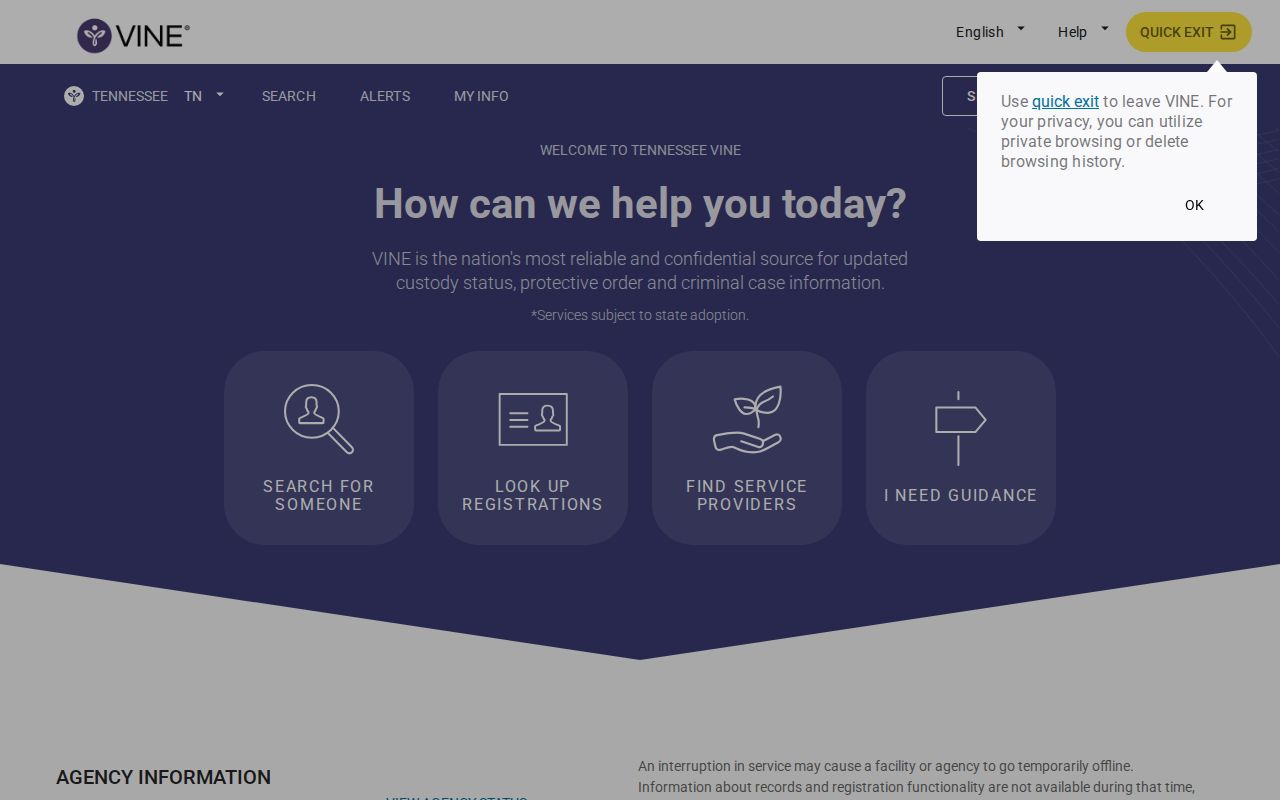
The captured interface identifies the official Tennessee route. A live person result must still be read on its own terms because the screenshot does not prove that Scott County jail feeds every event.
Register Scott County Release Alerts
Register before the expected custody event whenever the matched record offers notifications. Tennessee guidance lists phone, email, TTY, and text. The available choices may vary in the live interface. Keep contact details private and review each screen before submitting. Registration connects a notice to a custody record; it does not change the record or create a release decision.
Telephone alerts have a specific acknowledgment step. Official Tennessee VINE guidance documents a chosen PIN entered when prompted. That PIN acknowledges the automated call, and calls may continue for up to 24 hours until the PIN is entered. The PIN is not needed to conduct a name search. Do not assume email and text use that same process because the static Tennessee sources did not establish it.
- Open the correct person record and confirm the reporting agency and offender ID.
- Select the notification or registration option offered for that custody record.
- Choose phone, email, TTY, or text from the channels shown by the current screen.
- For a telephone alert, create and retain the PIN requested by the system so calls can be acknowledged.
- Follow the live confirmation steps for email, text, or TTY without assuming they use the telephone PIN.
- Keep the event message when lawfully received, then confirm the event with the reporting custodian.
Tennessee VINE support is available at 888-868-4631 around the clock. Support can address use of the service, while the Sheriff or TDOC remains the source for the actual custody and release record.
Verify Scott County Release Alerts
A VINE alert means the reporting agency recorded a custody change. It may describe release to the community, transfer to TDOC, movement to another jail, pickup by ICE, or a different event represented by the agency’s own label. Ask two questions after receiving it: did Scott County or TDOC custody end, and did another authority receive the person?
For the county jail, check the official iSOMS Intake/Release view and its populated Release Date, then call the Scott County Sheriff at 423-663-3111 if the disposition is unclear. Ask for the receiving authority when transfer is possible. For a state felony case, compare the alert with TDOC FOIL. “Incarcerated” means confinement continues. “Parole” or “Probation” indicates community supervision, while “Inactive” needs the sentence and discharge record for context.
A court order can explain the legal basis, such as bond, dismissal, time served, probation, or commitment. It does not supply the physical exit time. Scott County’s jail record and the court’s minute or order answer different parts of the event. When exact proof matters, obtain both.
Note: A custody-change alert should trigger verification; it does not prove that a person returned to the community.
Scott County Release Channel Sweep
VINELink does not replace the other custody systems that may serve a Scott County case. Each portal follows one authority. Choosing the channel by custodian avoids treating a state, county, federal, or immigration event as though it came from the same database.
| Custody path | Primary check | Key limit |
|---|---|---|
| Scott County Justice Center | iSOMS 72-hour view, Released name search, Sheriff record | County VINE participation remains unverified |
| TDOC prison or supervision | VINELink alert plus FOIL status and release record | Alert may be a transfer; RED is not actual release |
| Federal BOP custody | BOP Inmate Locator | VINE does not replace the federal locator |
| ICE custody | ICE Online Detainee Locator | Recent released-person visibility is limited |
| USMS-only custody | Federal docket and actual custodian | No comparable public historical USMS locator |
A BOP locator result with a past release date applies only to BOP custody. ICE’s locator covers current detainees and people released from ICE custody within its recent window. A USMS defendant may require the federal docket and holding facility. None should be searched in VINE as a substitute for the proper agency source.
Scott County VINELink Check Limits
Notification delivery can lag, contact data can fail, and the reporting agency can update its record after an event. VINE should not be treated as a permanent archive. Static Tennessee sources also do not prove how long an out-of-custody profile remains visible. If an older Scott County event is missing, request the retained jail register or release record and use the court file to explain the legal basis.
Identity errors are another risk. Common names, aliases, and changed spellings can lead to the wrong record. Prefer an offender ID, then compare the name and all identifiers shown. Do not attribute a custody event merely because a same-name profile disappeared.
For a state release, TDOC’s actual movement record or Letter of Discharge is stronger than an anticipated date or alert. For a county event, a populated iSOMS Release Date and the underlying disposition are stronger than absence from the current roster. VINE adds timely notice. It does not erase the need for the originating record.
An older Scott County lookup should move from notification tools to retained records. Use the county's public-records process for the permanent jail-register entry and any existing booking or release record. Then compare the Circuit Court Clerk's disposition, judgment, bond order, or later minute. For an old TDOC event, use FOIL for discovery and the state archive request process for the discharge or movement file. This sequence preserves the difference between an alert that prompted action and the agency record that proves what happened.
Registry searches are narrower still. Tennessee sex- and drug-offender registries apply only to people with a legal registration duty. They are not general release lists and should never replace Scott County iSOMS, FOIL, VINE, BOP, ICE ODLS, or the responsible records custodian.