
Scott County Projected Release Dates
A projected date is a calculation or eligibility milestone based on the sentence data known at that time. An actual release date records a completed movement out of one agency’s custody. Tennessee records distinguish several dates because they answer different questions. Sentence Begin Date identifies the start used by TDOC. Release Eligibility Date marks the earliest point when parole consideration may begin. Sentence End Date reflects sentence expiration as calculated in the state record. The physical exit can occur before or after an expected milestone for lawful reasons.
Pretrial custody is different. A person held at the Scott County Justice Center before judgment may leave on bond, recognizance, dismissal, time served, or another court order, but no fixed release date exists merely because a hearing is set or a bond amount appears. Bond must be accepted, the order processed, and other holds cleared. Ask the Sheriff for the actual release disposition and the Scott County clerk for the controlling public order.
- Release Eligibility Date
- The earliest date parole consideration can begin under the governing Tennessee law and calculation.
- Sentence End Date
- The calculated end of a Tennessee sentence, subject to valid changes and later records.
- Actual release date
- The date a custodian records that its custody ended.
- Detainer
- A request or hold tied to another authority that can prevent community release.
Find Scott County Release Dates
Start with the authority that holds or sentenced the person. Scott County iSOMS is the local jail route. TDOC Felony Offender Information Lookup, known as FOIL, is the state felony route. The court file controls judgments and later orders. These sources overlap, but none can safely be substituted for all the others.
FOIL covers felony offenders currently or formerly in TDOC custody or supervision. A name search accepts first and last name, a race filter, and an aliases option. Identifier searches accept a TOMIS or TDOC ID and a State ID Number. The details can include Supervision Status, Assigned Location, sentence length, Sentence Begin Date, Sentence End Date, Release Eligibility Date, Parole Hearing Date, and Parole Hearing Result. TDOC warns that dates may change when more court documents arrive.
- Identify the custodian. Use Scott County records for the Justice Center and TDOC records for a state felony sentence.
- Search FOIL by TOMIS/TDOC ID or SID when possible. Match a name result with birth date and other identifiers.
- Read the exact label. Do not rename Release Eligibility Date as a guaranteed projected exit.
- Check Supervision Status, Assigned Location, active sentences, Sentence End Date, and the parole fields together.
- For a local sentence or pretrial case, ask the Scott County clerk for the judgment, bond order, jail-credit notation, and later modifying orders.
- Ask the Sheriff or TDOC for the final movement or release entry when actual timing is needed.
A person missing from the current Scott County roster may have been transferred to TDOC. FOIL showing “Incarcerated” confirms that confinement continues under the state, even though county custody ended. “Parole” or “Probation” points to community supervision. “Inactive” needs the sentence and discharge records for context.
Note: Use an agency ID whenever possible because a common-name match can attach the wrong sentence and date.
Scott County Release Eligibility Date
FOIL’s exact future-facing label is Release Eligibility Date, or RED. It is not “projected release date” or “tentative release date.” Under T.C.A. § 40-35-501(n), RED is the earliest date a felony inmate becomes eligible for parole, conditioned on good behavior. TDOC calculates RED and sentence expiration for TDOC felony offenders and for covered felony offenders serving one year or more locally.
Eligibility does not compel a grant. The Tennessee Board of Parole makes the parole decision, while TDOC handles the sentence calculation and community supervision. Even a favorable Board result is not the same as physical departure. A release plan may need approval, conditions may remain, and Board Operations must issue the appropriate certificate before release to supervision.
For many sentences affected by changes that took effect July 1, 2024, credits on felony terms over two years can move parole eligibility without changing Sentence End Date. Discipline can defer eligibility. That Scott County-specific search problem is why RED, Sentence End Date, the Board result, and actual movement must be read as separate facts.
Scott County Sentence Credit Rules
Tennessee does not have one universal rule requiring every person to “serve 85%.” The standard range framework can include different release-eligibility percentages, including 20 or 30 percent for especially mitigated cases, 30 percent for Range I, 35 percent for Range II, 45 percent for Range III, and 60 percent for career offenders. The judgment, offense, offense date, and controlling version of the statute determine which rule applies.
Section 40-35-501 also has offense-specific and date-specific exceptions. Subsection (i) has included serious offenses requiring 100 percent service less permitted credits, with a historical cap that credits cannot reduce service by more than 15 percent. That is the source of a common 85 percent floor in defined cases, not a rule for every Tennessee sentence. Other subsections can impose 70 percent, 85 percent, or true 100 percent treatment in specified windows.
T.C.A. § 41-21-236 permits discretionary sentence-reduction credits from one to sixteen days per month. No more than eight may come from good institutional behavior and eight from satisfactory program performance. Qualifying educational or nine-month therapeutic-community achievements can add a one-time 60-day credit, subject to exclusions. Credits are not a right. They may be withheld or removed for misconduct and classification conditions.
Determinate release is another narrow route, not a rule for all Scott County sentences. TDOC says some qualifying offenders with terms of one to two years must serve at least 30 percent before release to probation, and notice goes to the district attorney, Sheriff, and warden. Statutory exceptions still control. Confirm that the judgment and offense qualify before applying this category to one person.
No one should compute a Scott County release date by subtracting a generic percentage from the sentence. Use the judgment, TDOC calculation, credit record, Board action, and actual release movement. For a local TDOC felony, iSOMS does not provide a public good-time projection; ask the jail or TDOC sentence manager for the actual calculation.
Why Scott County Release Dates Change
A date can move because the source data or legal posture changes. Some changes affect eligibility, some affect sentence expiration, and some block physical release without changing either date. The type of change must be identified before the result can be explained.
| Factor | Possible effect | Record to check |
|---|---|---|
| New or amended judgment | Changes sentence terms, alignment, or credit | Scott County court judgment and later orders |
| Consecutive sentences | Extends the combined calculation | FOIL active sentences and judgments |
| Jail credit | Credits qualifying time already served | Judgment, jail-credit notation, TDOC calculation |
| Earned credit award or loss | Can move eligibility or another calculated milestone | TDOC sentence-credit record |
| Discipline | Can defer RED or remove discretionary credit | TDOC calculation and classification record |
| Detainer or pending charge | Can prevent community release or cause transfer | Release disposition and receiving authority |
| Parole decision and plan | Grant, denial, deferral, or plan review changes the path | FOIL result, Board record, release certificate |
A detainer deserves special care. Scott County may record the end of its custody while another jail, TDOC, ICE, or federal authority takes the person. The first release timestamp is real, but it is not release to the community. Ask the Sheriff to name the receiving agency.
Note: A changed date is not necessarily an error; compare the latest judgment, credit record, and custody authority.
Scott County Parole Date Effects
RED determines when parole consideration may begin. The Board then evaluates the case and records its action. Hearing types can include initial or grant, review, revocation, rescission, time-setting, and appeal. A hearing officer’s recommendation is not binding; the final action requires the Board’s voting process.
FOIL’s Parole Hearing Result is the public person-level route. Read the actual label, such as grant, denial, deferral, continuance, rescission, or revocation, when that is what the record shows. Do not translate an eligibility date into a grant or a grant into physical release. Release-plan approval and conditions can remain after the vote.
The Board’s parole decision and appeal page explains the formal result context.
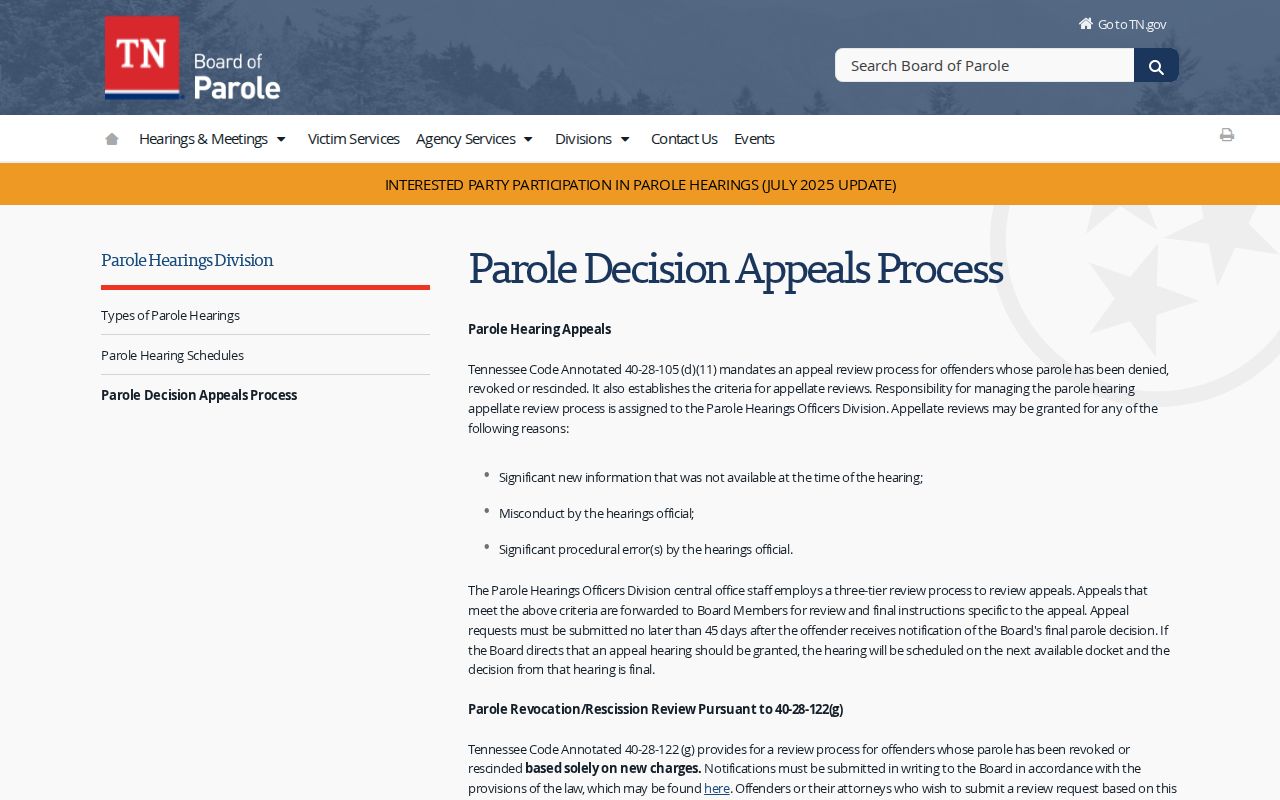
This official source helps distinguish a Board result from release itself. Appeals are limited to stated grounds and timing, and an appeal or changed decision can alter the expected path.
Confirm Scott County Actual Release
For a Scott County jail case, the official iSOMS 72-hour Intake/Release view can show a populated Release Date. The separate name search includes a Released control. A blank release field on a current record is consistent with continued county custody. Absence from the roster proves neither release nor transfer, so use the Scott County Sheriff and request the underlying booking/release record when the result is unclear.
For a TDOC sentence, Policy 511.03 provides for the CR-1941 Letter of Discharge. The signed original goes to the discharged person, and a copy is kept in the institutional file. TDOC’s CR-3626 release-notification record includes the person’s identity, TDOC ID, conviction details, release type, release date, sentence-expiration date, and intended-residence city and state. Those operational records are stronger proof of actual state release than RED.
Registering through the Scott County VINELink Release Check can add a timely custody-event alert when the reporting agency offers it. The notice must still be confirmed with the custodian. VINE does not replace BOP for federal custody or ICE’s locator for immigration custody.
A precise final answer pairs the calculation with the movement: the judgment shows the sentence, FOIL shows TDOC’s public dates and status, the Board record shows parole action, and the release or discharge record shows what actually occurred.
For an older state case, request the TDOC archive by full offender name, TOMIS number, date of birth, and a clear description of the release or discharge material sought. TDOC quotes any archive-search charge after the search and directs requesters not to prepay. A Scott County court file can supply amended judgments, jail-credit entries, and later orders that changed the calculation. Comparing those dated documents can explain why a past estimate differs from the actual movement without inventing a new formula.
County and federal dates still require their own custodians. Scott iSOMS does not calculate a TDOC RED, and FOIL does not archive every local booking. BOP release dates apply only to federal prison custody, while a USMS-only defendant may require the federal docket and holding agency. The authority behind the date is as important as the date itself.