
Scott County Parole and Probation
Parole and probation both allow a person to live in the community under rules, but they begin in different ways. The Tennessee Board of Parole decides whether an eligible prisoner may leave confinement on parole before the sentence ends. TDOC Community Supervision then oversees the parolee. Probation comes from a court order. It may be imposed without a prison term or after a period of split confinement, which means part of the sentence is served in jail and the rest under supervision.
A Board grant is one step, not proof of physical release. A release plan still must be approved, and Board Operations issues a parole certificate for release to community supervision. By contrast, a Scott County probation order identifies the legal basis for probation, while FOIL may show that TDOC is administering the supervision. Direct probation does not always create a past state-prison record. Read the court order and the public state status together.
| Point | Parole | Probation |
|---|---|---|
| Who authorizes it | Tennessee Board of Parole | Sentencing court |
| When it begins | After Board action, plan approval, and release from confinement | At sentencing or after split confinement, as the judgment directs |
| Who supervises | TDOC Community Supervision | TDOC Community Supervision for covered state cases |
| Main public proof | FOIL status, Board result, parole certificate, and release record | Court judgment or probation order, plus FOIL when covered |
| Does the sentence end | No, parole is served before sentence expiration | Not until the ordered term and lawful requirements end |
- Parole
- Conditional community release before a prison sentence expires.
- Probation
- Court-ordered community supervision, sometimes after a short period in jail.
- Discharge
- The formal end of a sentence or supervision obligation.
- Absconder
- A person officially found to have stopped reporting or left supervision without permission.
Verify Scott County Release Supervision
The public starting point is TDOC Felony Offender Information Lookup, known as FOIL. It covers felony offenders currently or formerly in TDOC custody or supervision. Search with a TDOC or TOMIS number or a State ID Number when possible. A name search also accepts first and last name, race, and an option to include aliases. The user must complete the case-sensitive CAPTCHA and then compare the result with known identifiers.
FOIL can display Supervision Status, Assigned Location, active Tennessee sentences, Sentence End Date, Release Eligibility Date, and Parole Hearing Result. “Parole” or “Probation” points to active community supervision. “Incarcerated” means custody continues even if the person is gone from the Scott County jail roster. “Inactive” is not a synonym for absconder, discharge, or release. It requires the sentence and status fields to be read as a whole.
- Search FOIL by TDOC/TOMIS ID or SID. If only a name is known, include aliases and compare the birth date and other identifiers.
- Open the matching record. Read Supervision Status and Assigned Location before drawing a conclusion from a sentence date.
- Check active Tennessee sentences and the Parole Hearing Result. A favorable result alone does not confirm that release occurred.
- Call the Scott Community Supervision office with the TOMIS number when a public status needs clarification. Ask for public status, not private case notes.
- Compare probation with the Scott County judgment or probation order. Compare parole with the Board record and actual release movement.
For the wider county release path, including iSOMS and court records, use the Scott County released inmate search. That route is useful when FOIL has no record because many local bond, dismissal, and misdemeanor cases never enter the state felony system.
Scott County Supervision Office
Scott County belongs to TDOC Community Supervision District 21. The local office is inside the Justice Center, though its listed street number differs from the county facility page for the jail. Use the address published in the TDOC field-office directory for supervision visits and confirm it before travel. Office assignments can change.
Staff can help clarify the public office assignment after the right FOIL record has been found. They may restrict case-management details, schedules, and personal information. A focused question gives the office a sound basis to respond: provide the TOMIS number, state the public status shown in FOIL, and ask whether that status maps to the Scott office.
TDOC Scott Community Supervision
Scott County Justice Center
575 Scott High Drive
Huntsville, TN 37756
Phone: 865-220-6529
Fax: 865-463-0784
The District 21 office is at 110 E. Centre Stage Business Park in Clinton. Its phone is 865-220-4001 and fax is 865-463-7084. The district serves Scott and seven other East Tennessee counties, so the assigned location field matters.
Note: Confirm the TDOC directory before visiting because supervision assignments and office details can change.
Scott County Parole Hearing Records
Scott County Jail can appear as a facility section on a Board hearing schedule when it has a docket. The Board says schedules are updated each Monday, or Tuesday after a Monday holiday. Schedule fields can include the facility, TOMIS number, person’s name, hearing type, and date. They remain subject to change, so use the Board’s schedule request address, BD.HearingSchedules@tn.gov, or call 615-741-1150 to confirm.
A hearing officer’s recommendation is not the final result. Required concurring Board votes create the decision. Depending on the record, the outcome may be a grant, denial, deferral, continuance, rescission, revocation, or another stated action. FOIL’s Parole Hearing Result is the main public person-level route. Formal records can be requested from the Board, and appeals are limited to the grounds and deadline described in the Board appeal process.
The Board hearing page shows the schedule route and hearing framework.
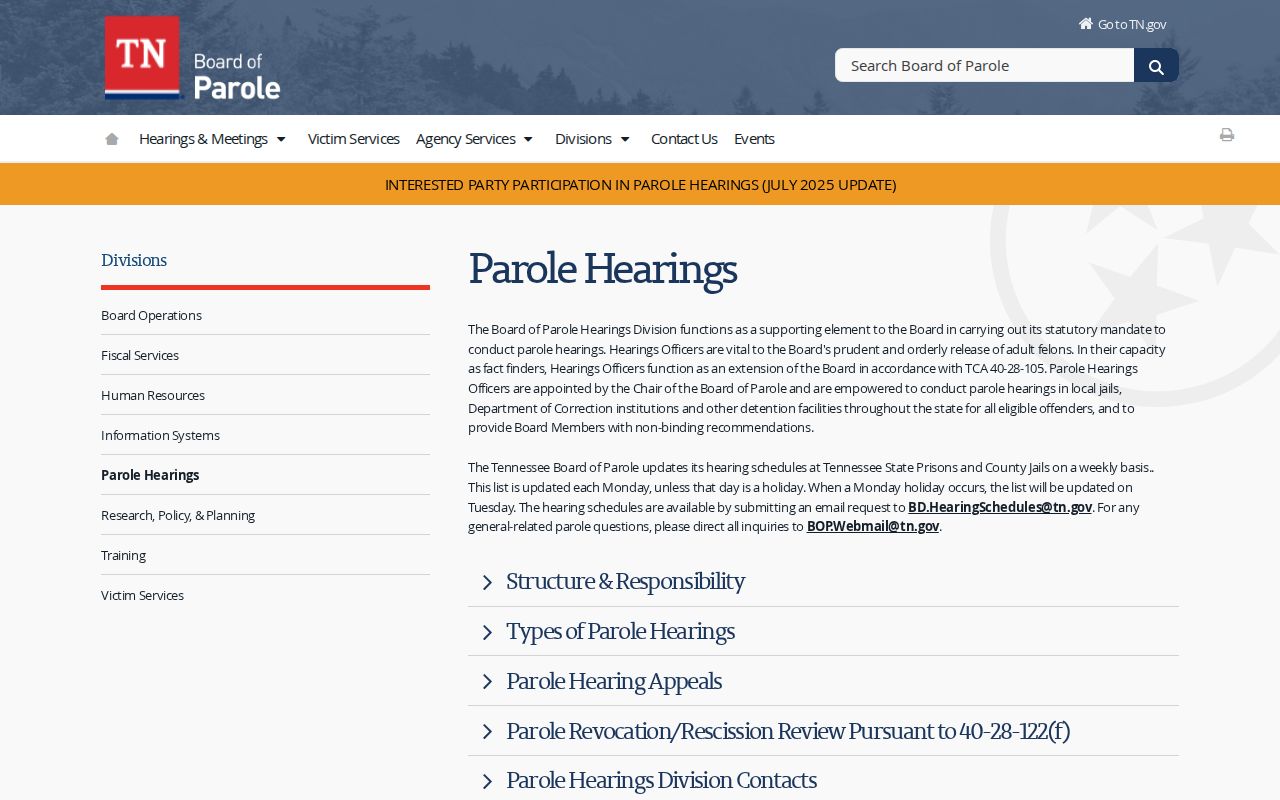
This official Board view supports checking hearing procedure while FOIL remains the person-level status source. A scheduled hearing or grant still must not be reported as an actual release.
Scott County Supervision Violations
Conditions vary by judgment, parole certificate, and approved plan. At a high level, a supervised person may have reporting, travel, treatment, payment, residence, or conduct rules. A suspected breach does not itself establish a violation. The supervising agency and court or Board process determine what happened, whether a warrant exists, and whether supervision was modified or revoked.
No authoritative public Scott County or statewide TDOC absconder list was found in the research sweep. Do not convert an “Inactive” FOIL label into an absconder claim. A warrant, revocation, or official absconder status needs agency or court proof. For an interstate compact case supervised in Tennessee, the Interstate Compact public lookup is a separate official route. It is not a Scott County release list.
When a person is taken back into custody, FOIL, a court revocation record, or a Board hearing result may change at different times. Compare dates and authorities. The Scott County VINELink Release Check can send a custody-change alert for a participating agency, but a notice is not a final violation finding and may describe a transfer. The Tennessee Sex Offender Registry is relevant only for a person with a legal registration duty. It is not a general parole or probation list, and its absence proves nothing about supervision.
Note: An inactive FOIL record does not establish a warrant, an absconding finding, or the end of supervision.
Scott County Recovery Court Role
Scott County Recovery Court is a named General Sessions program operated by county government. It can be a useful local point only when a court record shows that the person participates. It is not an inmate locator, a general reentry office, or proof that someone is on probation. The judgment, docket, or program record must supply that link.
The Tennessee Recovery Court directory lists Becki Harper at 101 Marcum Road, Oneida, TN 37841, phone 423-286-2982. Questions should be limited to the program’s proper role and the requester’s lawful access. An arrest or release entry alone is not enough to infer treatment or program participation.
Scott County Recovery Court is distinct from TDOC supervision. Recovery Court is tied to the local General Sessions process, while FOIL and District 21 address state community supervision. Keeping those channels separate prevents a local program contact from being treated as a statewide status source.
Scott County Release Property Records
Release-day proof can exist outside a web roster. Tennessee’s sheriff records-retention schedule treats the signed property-return receipt as a permanent record. The receipt inventories cash, valuables, and property, and it is signed by the released person and witnessed by an officer. It may corroborate the day Scott County custody ended even after an online result rolls off.
The receipt does not show that parole or probation began. Nor does it prove that the person returned to the community rather than being transferred. Pair it with the release disposition, receiving-agency field, FOIL status, and court order. Jail-record corrections belong with the Sheriff or records custodian.
After release, the Scott County Clerk offers a local route for duplicate driver-license transactions. That service can help with identification needs, but it does not change a jail record or verify supervision. These two functions should not be confused merely because both arise after release.
Note: A permanent property receipt can support a release date, but only the supervision record identifies parole or probation.
Scott County Supervision Discharge
Supervision ends through the lawful completion or discharge shown in the governing record. A past Sentence End Date can help, but it is not the same as a formal discharge record. FOIL may move to inactive after state custody or supervision ends. Read that label with active-sentence data, status history, and the institutional record instead of using it alone.
For a state sentence, TDOC Policy 511.03 provides for a signed CR-1941 Letter of Discharge. The original goes to the discharged person and a copy remains in the institutional file. An archived request can seek that letter, the final supervision status, and the release or discharge entry. TDOC archive fees are quoted after the search, so no prepayment should be sent without an estimate.
A parolee remains under sentence until discharge. A probationer remains bound by the court’s order until lawful completion or a later order. If a violation, amended judgment, detainer, or new case changes the timeline, use the final agency or court record. That is stronger proof than a roster disappearance, a stale alert, or an assumed date.