
Federal Prison Release Paths
No federal prison was identified inside Scott County. The Federal Bureau of Prisons page is a nationwide custody route for a person whose federal case led to BOP confinement. A person may leave BOP for the community, a detainer held by another government, another form of lawful custody, or supervision outside a prison. BOP's end of custody does not state that every other authority released the person.
A federal defendant can also move through the U.S. Marshals Service before commitment to BOP. Some pretrial defendants, material witnesses, or civil-contempt detainees may appear in federal records without serving a federal prison sentence. If a federal docket shows remand but the BOP locator has no useful record, identify the actual custodian or contact the U.S. Marshals Service district. The U.S. Marshals Service custody page explains that separate route.
| Federal path | What public status can establish | What it cannot establish alone |
|---|---|---|
| BOP “Released” with past date | BOP custody ended on the listed date | No later custody or supervision |
| “Not in BOP Custody” | The person is not currently held by BOP | Community release from every authority |
| “In Transit” | A federal movement is underway | Release |
| Community Corrections Management | A community placement relationship with BOP | End of BOP custody |
| USMS remand | Federal court custody may exist | Commitment to BOP |
Search Federal Release Records
The BOP Inmate Locator is the first public search for a federal prisoner. Identifier searches can use a BOP register number and, where accepted, DCDC, FBI, or INS numbers. A name search uses first, middle, and last name with optional race, age, and sex refiners. An agency number is safer than a common name.
Follow a short check.
- Choose the number search when a verified federal identifier is available.
- Otherwise enter the complete name and use refiners only to separate results.
- Compare name, register number, age, race, and sex before selecting a record.
- Read Release Date and Location together.
- Distinguish a past Released result from In Transit, Unknown, or a community corrections entry.
- Use the federal docket or an agency record when the locator does not explain the disposition.
BOP says the locator updates daily. A recent legal event may not appear at once, and First Step Act recalculations can make some dates temporarily stale. Match the person carefully and verify an urgent event with the responsible office.
BOP Release Record Fields
Public locator results show name, register number, current age, race, sex, release date, and location. A past date combined with Released and no current facility is the key public sign that BOP custody ended. A future date is projected and can change. “UNKNOWN” means the confinement term is not determined, while “IN TRANSIT” describes movement rather than release.
| Field | Use in release confirmation |
|---|---|
| Name and register number | Match the federal identity |
| Age, race, and sex | Separate same-name results without replacing the identifier |
| Release Date | Shows the listed past or projected federal date |
| Location | Distinguishes a facility, released status, transit, or community corrections relationship |
The BOP explanation of locator records supplies the coverage and status context shown in the captured image.
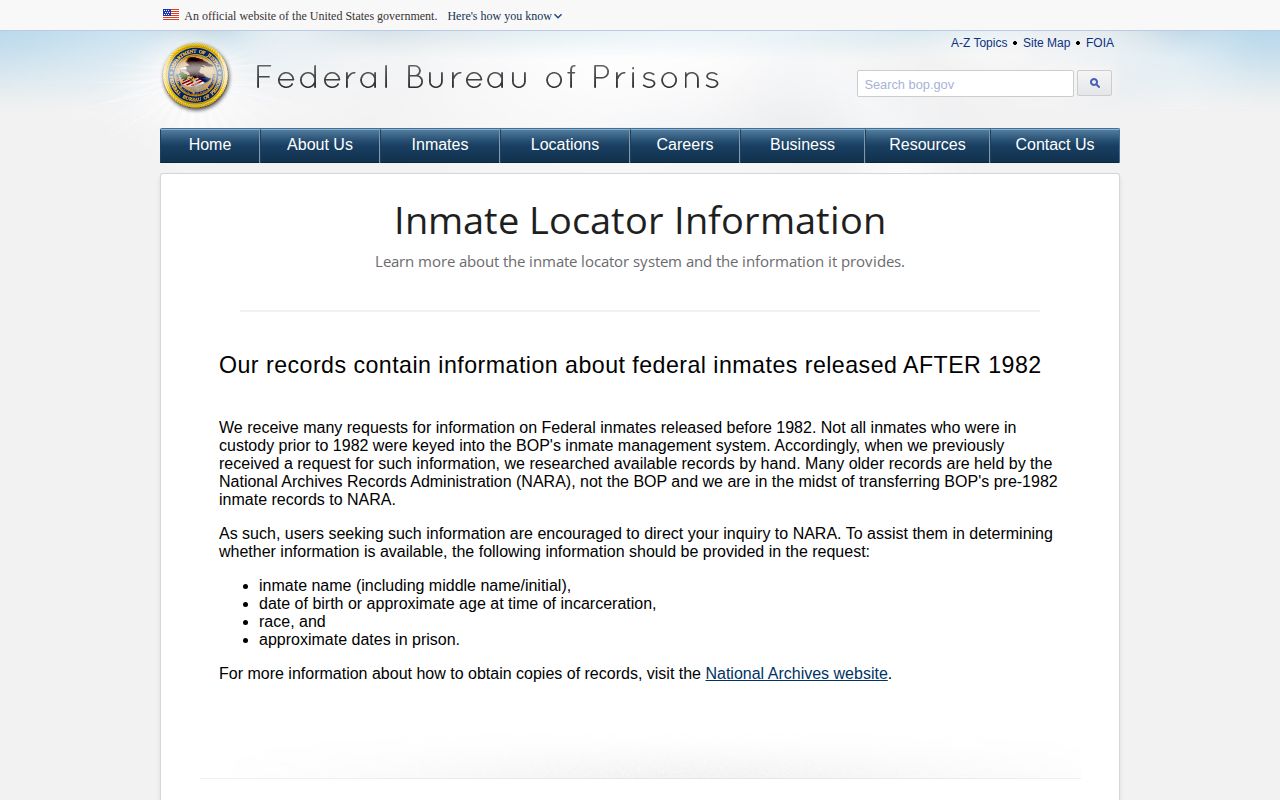
The screenshot documents the official federal source. It is not proof of any named person's release without a matched result and date.
Federal Release Coverage Limits
BOP public coverage principally reaches federal prisoners released from 1982 onward. An older federal file may require the National Archives or another historical records route. The locator can also contain people who were held for federal reasons but did not serve an ordinary sentenced prison term. Read the docket and agency role before describing the case.
A BOP release date answers only when BOP custody ended. Federal supervised release can follow imprisonment and is not the same as custody in a BOP prison. Federal parole remains relevant to some older legal frameworks, but it should not be assumed from a release line. A detainer can send the person directly to another sovereign. Form BP-A714, Notice of Release and Arrival, is useful because it distinguishes release to the community from release to a detainer and records destination, transportation, reporting, and supervision information.
- Sovereign
- A government authority, such as federal, state, local, or immigration, that can hold custody under its own law.
- Detainer
- A request or hold supporting transfer to another authority when one custody ends.
- Supervised release
- Federal court supervision after imprisonment, distinct from BOP prison custody.
- Register number
- The identifying number used to match a person in BOP records.
Note: A past federal release date should be paired with the location field and any known receiving-authority record.
Request Federal Release Records
The public locator is discovery, not the full institutional file. For the actual federal release type, receiving authority, or movement details, use the BOP Freedom of Information Act route. Describe the record and date range precisely, and include the person's full name and register number when known. Privacy Act and FOIA exemptions can limit another person's details.
Federal Bureau of Prisons Records
Public search: BOP Inmate Locator
Historical/detail route: BOP FOIA
Coverage: Nationwide BOP custody
No BOP prison was identified in Scott County.
The official FOIA capture below shows the source for records beyond the locator.
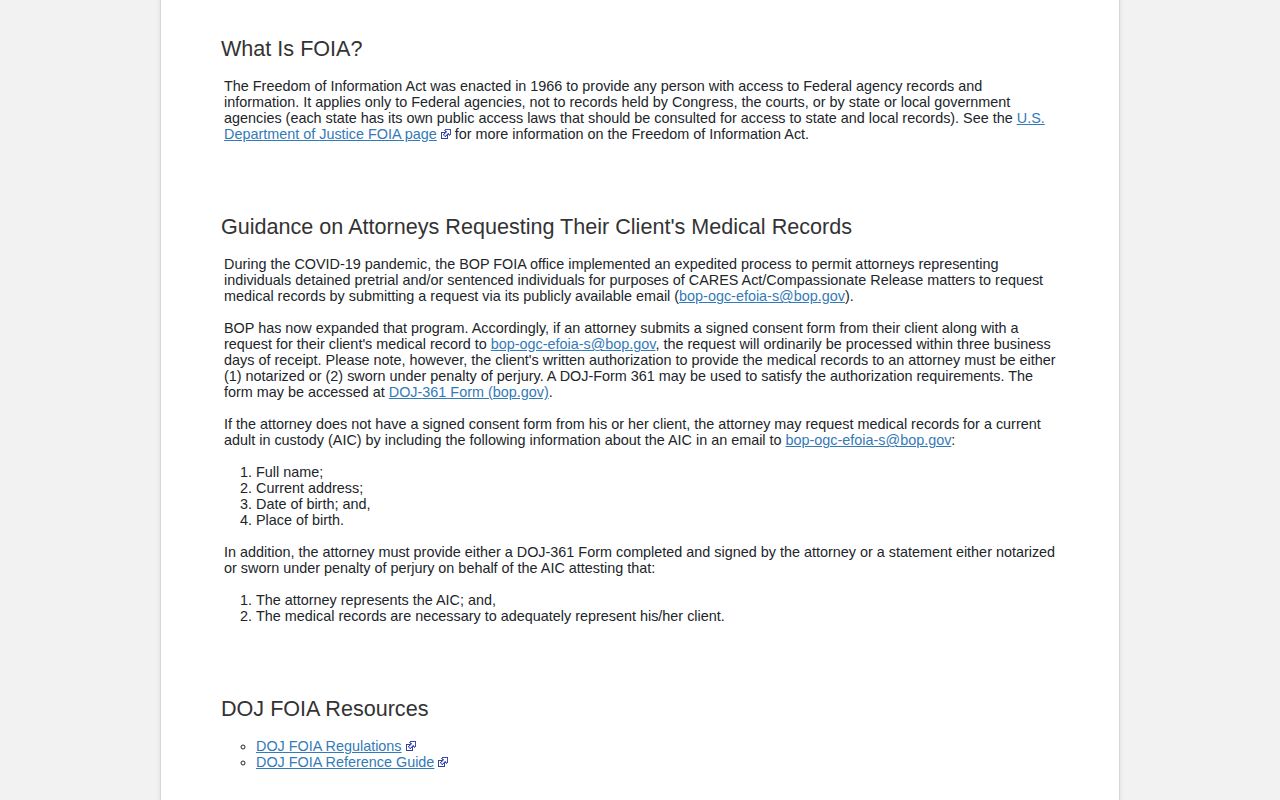
A focused request may seek the release movement, BP-A714 notice, destination, or detainer disposition. The FOIA page does not itself confirm a release. It tells the requester where the Bureau handles qualifying federal records.
Scott County Federal Releases
A Scott County connection does not make a federal record part of the county jail system. A person charged federally may be arrested in Tennessee, held in a contract facility outside Scott County, moved through USMS custody, and later committed to a BOP prison elsewhere. The Scott County Sheriff's links and 72-hour feed can document a local segment, but not the federal history for that sequence.
If the person began at the Scott County Justice Center and the local record names a federal transfer, use the county's public-records process to request the release disposition first. That proves when Scott County custody ended and identifies the next authority. Then inspect the federal docket. Use BOP only after BOP custody is plausible, and use USMS or the actual holding jail when the person was not committed there.
If immigration custody may have followed BOP, search ICE ODLS within its current and recent-release scope. A BOP “Released” result followed by an ICE custody record represents a change of sovereign, not a return to the community. Avoid merging the two dates into one event.
Verify Federal Release Disposition
A reliable federal release account has three parts: the correct identity, the end date for BOP custody, and the next legal status. The register number provides the strongest public identity match. The locator supplies the federal date and location label. A notice, docket entry, supervision record, or receiving-authority entry supplies the disposition. For a local custody segment, use the Scott County release search and records route separately.
Do not treat a future date as fixed. Court action, sentence recalculation, credits, detainers, and agency processing can affect it. Do not treat “unknown” as release. Do not treat community corrections as an unconditional end of custody. Each label has a narrower meaning than everyday language suggests.
Form BP-A714 can close a gap that the locator leaves open. Its purpose is to give notice of release and arrival, and its fields distinguish a community destination from a detainer destination. Transportation, reporting, and supervision details help show what happened next. Access can still be limited by federal privacy law, so a requester should identify the exact form or release movement and explain the record sought without assuming every field is public. The form is stronger for disposition than a bare locator date because it was designed around the actual release process.
When the locator and docket differ, record the date of each source and ask BOP for the underlying file. A current agency record usually gives the best answer to the fact that agency controls. This method keeps a Scott County federal release search tied to federal evidence instead of local assumptions.
Older federal releases need a different expectation. BOP says its public data principally covers people released from federal custody from 1982 forward. A person released before that period may require the National Archives, while a later file may still require FOIA for its release disposition. Search coverage is not the same as record retention. State FOIL, county iSOMS, and ICE ODLS cannot fill a missing historical BOP record because each belongs to a different authority.