
Understanding Scott County Releases
A release means one agency ended its custody. It does not always mean the person went home. Someone may leave the Scott County Justice Center after bond, recognizance, dismissal, time served, sentence expiration, or another court order. The same exit can instead be a transfer to the Tennessee Department of Correction, another jail, federal custody, or immigration custody. The event record must be read with its release disposition or receiving authority.
Scott County released inmates usually leave the current jail roster because that roster describes who is housed now. The county's event view, Released name search, jail register, and release order preserve different parts of the story. A court minute can state why release was authorized. FOIL can show that state custody or supervision followed. The right proof depends on whether the question is when county custody ended, why it ended, or where the person went next.
- Time served
- A court credits enough confinement to satisfy the ordered jail term.
- Parole
- The Board permits community release before sentence expiration, subject to supervision.
- Probation
- A court orders community supervision, either directly or after split confinement.
- Discharge
- A sentence or supervision term ends, with no other custody basis implied.
- Detainer
- Another authority asks to take custody when the current agency is ready to release.
Scott County Release Paths
The exit type determines which record is most useful. An iSOMS Release Date can establish that Scott County custody ended, but it may not explain the legal ground or final destination. Use the court file for authority and the receiving system for continued custody. These records work together.
| Release path | What it means | Where to verify next |
|---|---|---|
| Bond or recognizance | The court permits community release while the case continues. | iSOMS release entry and bond order |
| Dismissal or time served | A court disposition supports the end of local custody. | Jail record plus clerk's minute or judgment |
| Sentence expiration | The custodial term ends, subject to any other hold. | Release record and sentence record |
| TDOC transfer | County custody ends while state custody continues. | FOIL status and assigned location |
| Federal or ICE pickup | Another sovereign takes custody. | Federal docket, BOP locator, or ICE ODLS |
Can a person be released from Scott County but still be confined? Yes. A transfer ends Scott County custody without releasing the person to the community. Ask for both the disposition and receiving agency.
Note: A Scott County release timestamp confirms one custody exit, not the person's final destination.
Scott County Release Record Fields
A strong request identifies the person, the booking, the event, and what happened after the exit. Scott County has not published a promise that every field below appears on every iSOMS detail. The table is a request checklist drawn from the county jail, court, and state release records. Ask for an existing record rather than a new narrative.
| Field | What it shows |
|---|---|
| Name, aliases, DOB | Helps distinguish people with similar names. |
| Booking or agency ID | Links the release to the correct custody record. |
| Intake date and facility | Identifies the Scott County custody episode. |
| Charge, court, and bond | Connects jail data to the legal case. |
| Actual release date and time | States when the holding agency ended custody. |
| Release disposition | May show bond, time served, expiration, or transfer. |
| Order or court reference | Points to the authority for the release. |
| Receiving agency | Shows whether custody continued elsewhere. |
| Booking photograph | Ties an existing identification image to the booking. |
State records use added fields. TDOC form CR-3626 separates release type, release date, sentence-expiration date, and intended residence. The CR-1941 Letter of Discharge is signed and placed in the institutional file, with the original given to the discharged person. Those records are more direct proof of state release than a date that only marks parole eligibility.
Request Scott County Release Records
The Scott County public-records process covers existing open records. It does not require the custodian to build a report that does not exist. Give enough detail to locate the right booking and ask for electronic inspection or copies when practical. No current Scott County copying rate was verified, so request a written estimate before accepting charges.
- Identify the full name, aliases, approximate booking dates, and any known booking or case number.
- Describe the existing booking and release record, jail-register entry, release order, and booking image sought.
- Use the county's official request form and send it to Public Records Coordinator Ruth Harness.
- Ask for reasonably segregable nonexempt fields if part of the record is withheld.
- Request the legal basis for any denial or redaction and ask for a cost estimate.
Ruth Harness
2845 Baker Highway
Huntsville, TN 37756
423-663-2000
ruth.harness@scottcounty.com
Under the Tennessee Public Records Act, a Tennessee citizen may inspect open records during business hours. The custodian must promptly make the record available or, when prompt production is not practical, respond within seven business days with production, denial, or an estimated time. Electronic copies may be provided when readily available. State model copying rates are context only and are not a guaranteed Scott County charge.
Scott County Release Record Law
T.C.A. § 10-7-503 supplies Tennessee's basic right of access to open public records, subject to lawful exceptions. Section 10-7-506 addresses copies and reasonable charges. Scott County release records can include protected or redacted information, and juvenile custody records follow a separate confidentiality framework. An expunged or sealed court record may no longer be available through normal public access.
Retention also varies by record series. Tennessee county guidance treats the jail register as permanent. Booking, movement, and release-order series may have five-year periods after the relevant event, while identification photographs and signed property-return receipts have longer retention rules. A short web view is not the retention schedule. For an old event, request the retained jail register and the court file rather than treating an empty web search as proof that no record exists.
Online removal and legal destruction are different. Ask the custodian which underlying record remains and which rule governs access.
Note: The permanent jail register can remain available after a short online release result disappears.
Scott County Release Property Records
A signed property-return receipt can corroborate a Scott County release even after a rolling roster entry disappears. Tennessee retention guidance calls for permanent retention of the signed receipt that inventories cash, valuables, and other property returned at release. This is a distinct record, not a substitute for the release disposition. It may help establish what was handled at the end of custody.
Scott County also provides a local route for a duplicate driver license through the County Clerk. That service can help with identification after release, but it does not change or correct a jail record. Errors in a booking or release record must go to the Sheriff or lawful custodian. The Clerk's service is at 283 Court Street in Huntsville, with weekday transactions from 8:00 a.m. to 4:00 p.m. and requested arrival by 3:45 p.m.
Scott County Two-Record Proof
The adult jail and the Circuit, Criminal, and General Sessions clerk are in the same Justice Center. That local setup supports a useful two-record method. The jail entry proves the physical custody event. The court minute, judgment, dismissal, bond order, or probation order explains the legal basis. Neither should be forced to answer the other's question.
For bond, a dollar figure alone does not prove release. The record should show that the bond was accepted and that no other hold blocked departure. For dismissal or time served, compare the final court entry with the jail's actual Release Date. A court order may precede physical processing, while a jail exit may lead straight to another custodian. Call the Scott County Circuit Court Clerk at 423-663-2440 when the public record needs a minute or order.
Find Scott County Released Inmates
Use a custody-aware sequence. Start with the county event source, then expand only when the facts point elsewhere. Names alone are weak identifiers, so compare a middle name, date of birth, booking number, case, agency ID, and event date when available.
- Open the official 72-hour iSOMS Intake/Release view and distinguish an intake from a release.
- Use the separate name search with its Released control if the event is outside the rolling view.
- Call Sheriff Brian Keeton's office at 423-663-3111 and ask when Scott custody ended and where the person went.
- Request the booking/release record and compare it with the court disposition.
- Search FOIL if a TDOC sentence, transfer, parole, or probation is plausible.
- Use VINE for alerts, BOP for federal prison records, and ICE ODLS for current or recent immigration custody.
- For a USMS-only case, use the federal docket and actual custodian because USMS has no comparable historical public locator.
A missing name on the current Scott County roster does not prove community release. It may reflect transfer, another custodian, or a matching issue.
For a time-filtered scan, the Scott County releases from the last 24 hours explains how to apply a one-day cutoff to the official three-day source. Older events call for the Released name search, retained jail records, and court files.
Note: Match names with booking, case, or agency identifiers before attributing a Scott County release event.
Scott County Recent Release Search
The Sheriff's official product is labeled “Jail Intake/Release (Last 72 hours)”. It is a combined event list, not a releases-only archive. Individual records include a Release Date, and the separate name search provides First Name, Last Name, and Released controls. The county publishes no separate official 24-hour page, no exact refresh promise, and no stated online retention period.
Read the event type and timestamp. A row inside the time window may be an intake. A blank Release Date on a current record is consistent with continued county custody, while a populated past date is the strongest public web sign that Scott County ended custody. It still does not prove the person went home. For a rolled-off or missing result, call the Sheriff and request the permanent jail-register entry and release record.
Note: The county government app and Sheriff Facebook page were not verified as complete inmate or release feeds.
Scott County FOIL Release Search
TDOC's Felony Offender Information Lookup covers Tennessee felony offenders currently or formerly in state custody or supervision. It can follow a Scott County person who transferred to state custody, entered parole or probation, or became inactive in the TDOC system. It does not cover every county arrest, dismissed case, misdemeanor, or pretrial bond release.
| Search route | Input | Best use |
|---|---|---|
| Name | Last and first name, race filter, alias option | Discovery when no ID is known |
| TDOC/TOMIS ID | Agency identification number | Strong match to one state record |
| SID | State identification number | Alternative identifier match |
Read Supervision Status, Assigned Location, Sentence End Date, Release Eligibility Date, parole hearing fields, and active Tennessee sentences together. “Incarcerated” means custody continues. “Parole” or “Probation” means community supervision continues. “Inactive” can point to a former state record, but does not by itself disclose the release type.
The official FOIL overview describes the records available through the state system.
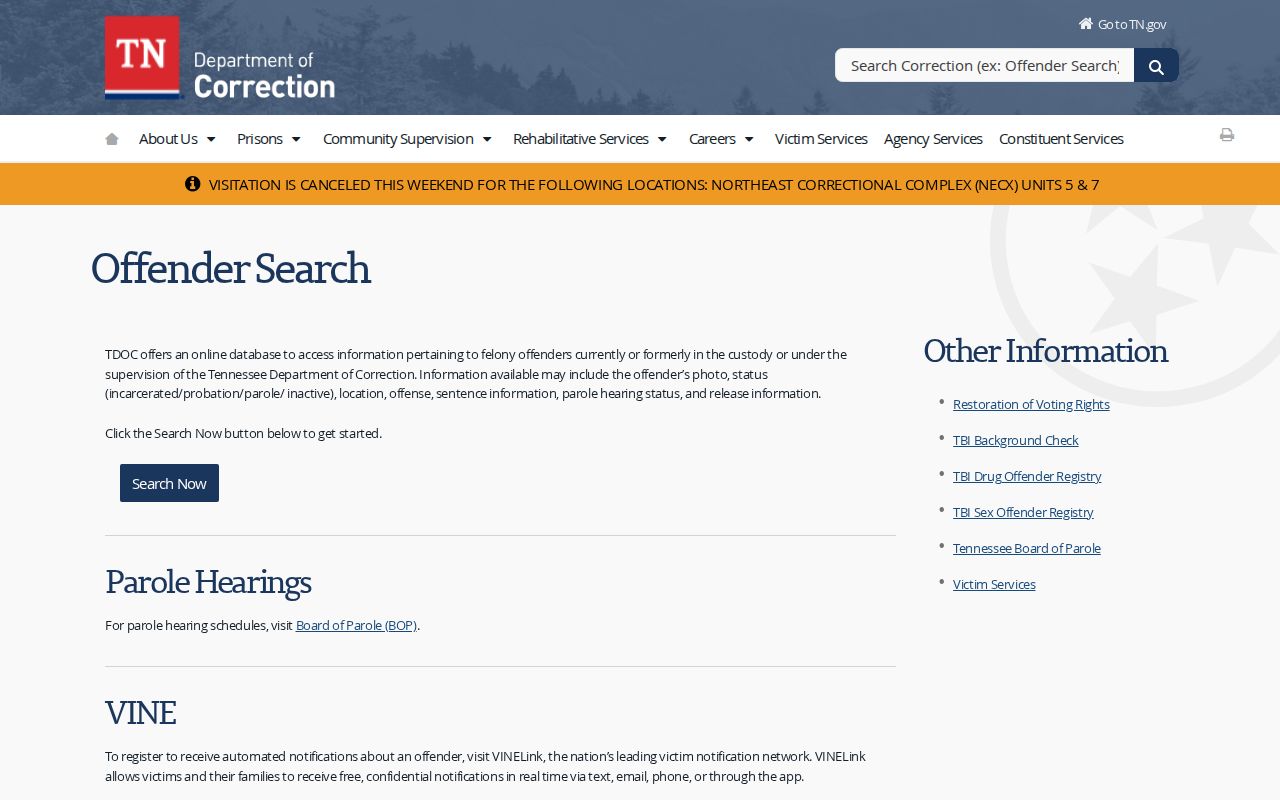
The state overview explains why FOIL can remain useful after a person is no longer shown in Scott County's current jail data. Exact release proof may still require the TDOC movement record or Letter of Discharge.
Note: Release Eligibility Date marks possible parole review timing and never proves physical departure.
Scott County Custody Status Sources
Each official system has a defined reach. Choose the system that held the person and the time period involved. Do not treat one locator as a universal record.
| Source | What it can show | Main limit |
|---|---|---|
| Current iSOMS database | People presently housed at the Justice Center | Absence is not release proof |
| 72-hour iSOMS and Released search | Recent event and county Release Date | Combined intake/release view; archive depth unstated |
| TDOC FOIL | State custody, supervision, or inactive status | Not every Scott County booking enters TDOC |
| Court file | Bond, dismissal, judgment, sentence, probation, or later order | May not show the physical exit time |
| BOP locator | Federal prison status and past release date after 1982 | Does not cover county, TDOC, or USMS-only custody |
| ICE ODLS | Current detainees and releases within 60 days | Short window and no minors |
Scott County Custody Snapshot
TDOC's January 2025 one-day jail summary reported 125 people against 140 Scott County beds. The count included 40 TDOC backup prisoners. A backup prisoner is a state-sentenced person housed locally, so this figure shows why a disappearance from the Scott roster may lead into state custody.
Those figures are not releases, bookings, annual totals, turnover, or average stay. They are a dated census. Monthly reports can use different bed and population definitions, so separate snapshots should not be combined into a trend without checking the reporting basis.
Scott County Release Supervision
The Tennessee Board of Parole makes parole decisions. TDOC Community Supervision administers parole and probation. FOIL is the public person-level lookup, and the Scott office inside the Justice Center is the local follow-up point. A favorable Board result does not prove the person physically left custody because release-plan approval and final movement still matter.
Scott County is in Community Supervision District 21. The local office is at 575 Scott High Drive, Huntsville, TN 37756, and its phone is 865-220-6529. Ask staff how to verify public supervision status using the TOMIS number. Direct probation may follow a court order without a state-prison stay, while parole follows Board-authorized release from incarceration. An “Inactive” FOIL label does not mean absconded.
Note: Public supervision status does not disclose confidential case-management notes or prove a violation.
Scott County Recovery Court Records
Scott County Recovery Court is a named General Sessions program operated by county government. It can be a useful navigation point only when the case record establishes that the person participates. It is not an inmate locator, a broad reentry office, or proof of supervision.
The program contact is Becki Harper at 101 Marcum Road, Oneida, TN 37841, with phone 423-286-2982. Confirm participation through the court or program rather than inferring it from an arrest, release, or charge. The court file remains the source for the order placing a person into the program.
Travel After Scott County Release
ETHRA offers advance-scheduled, door-to-door public transportation in its East Tennessee service area. It asks for three business days' notice, so it is not an on-demand ride from the Justice Center. Published fares are $3 each way within the county, another $3 for each county line, and $1 for an added short stop. Confirm the current fare and schedule before relying on the service.
Scott County has not published a standard release door, release time, family waiting area, property-pickup process, or on-demand transport plan. Those gaps matter. Do not apply a practice from another jail. ETHRA can be planned in advance at 800-232-1565, but a same-day release may require a different personal travel plan.
Note: ETHRA requires advance scheduling and is not an on-demand Justice Center release shuttle.
Scott County Release Site History
Scott County's 1904 sandstone jail held about 50 people and closed for good in 2008 when the current Justice Center opened. It is historical context, not a live custody or release source. A search tied to the old building will not confirm a current event.
The current Justice Center is the adult detention and principal local criminal-court location. Use the Sheriff's iSOMS links for recent custody events and the clerk's files for legal disposition. Older records may still refer to the former jail, but present confirmation belongs with the agency that retained the record.
Scott County Release Alerts
Tennessee VINE covers TDOC and can send custody-event notices by phone, email, TTY, or text. Scott County jail participation was not independently confirmed by a named official source. Search one person, match identifiers, and register before the expected event when the option appears. Treat any alert as a prompt to confirm with the reporting custodian because a reported release can be a transfer.
Federal paths are separate. BOP's locator covers federal prisoners released after 1982 and can show a past release date. ICE ODLS covers current detainees and people released from ICE custody during the preceding 60 days. A county handoff under an ICE detainer is not a community release. USMS custody may require the federal docket and actual holding facility because USMS offers no public former-detainee archive like BOP.
Scott County Release Facilities
The facility map separates physical sites from systems that may receive or record a person after Scott County custody. The Justice Center is the primary adult county jail. Juvenile detention follows restricted access rules and must not be folded into an adult released-person search. No TDOC prison, federal prison, or ICE detention facility was identified inside Scott County, but those systems remain relevant to transfers and outside custody.
- Scott County Justice Center: check recent iSOMS events, the Released search, Sheriff records, and court disposition.
- Scott County Juvenile Detention Center: authorized inquiries belong with the juvenile court or facility.
- Tennessee Department of Correction: use FOIL and TDOC discharge records for state custody.
- Federal Bureau of Prisons: use the BOP locator for federal prison status and release dates.
- ICE Detention: use ODLS for current or recent immigration custody.
- U.S. Marshals Service Custody: use the federal docket, holding authority, and BOP when commitment occurred.